
If you ask ten Bangkok families what they want from childcare, most will say the same thing: someone reliable, calm under pressure, and great with children in real life - not just in an interview. That is why the babysitter to nanny Bangkok path matters so much for both caregivers and parents.
What changes when a babysitter becomes a nanny in Bangkok
A babysitter is usually hired for coverage: date nights, school pickup backups, or short blocks during busy weeks. A nanny is hired for continuity. And a lead nanny is hired for leadership inside the family routine.
In practical terms, the role expands in three ways. First, responsibility shifts from "watching" to planning - naps, school transitions, activities, and communication with parents. Second, consistency becomes non-negotiable. Families can accept occasional schedule changes from a casual babysitter, but not from the person who anchors weekday life. Third, communication quality becomes part of the job itself. In Bangkok's expat-heavy neighborhoods, caregivers who can explain what happened during the day in clear English often move faster into premium roles.
For families comparing options, role clarity matters before hiring. If your household needs occasional support, a babysitter profile may be enough. If you need daily structure, you should browse dedicated nanny profiles and expectations on .
The 4-stage career ladder from first jobs to lead nanny roles
Most successful caregivers in Bangkok do not leap directly into top-tier jobs. They move in stages, and each stage creates proof for the next one.

Stage 1: Trust-building through basic reliability. This is where many caregivers start with part-time babysitting blocks. The main goal is not income maximization yet. It is reference quality. Families remember punctuality, emotional regulation with kids, and whether communication is proactive when things go wrong.
Stage 2: Routine ownership. At this point, caregivers begin handling recurring weekday responsibilities, not just one-off sessions. They start coordinating meals, transitions, homework windows, and activity rhythms. Pay usually increases because families are paying for lower household stress, not just hours.
Stage 3: Professional differentiation. Caregivers add visible skills families can verify - infant care confidence, first-aid readiness, bilingual communication, or support for children with specific developmental needs. This is often where earnings separate meaningfully from entry-level childcare.
Stage 4: Lead nanny positioning. Here, the caregiver is trusted to run a stable system: handoffs with parents, schedule adaptation during school changes, and calm emergency escalation. Families hiring at this level are choosing risk reduction and consistency, not the lowest rate.
If you are a parent reading this, the fastest way to identify where a candidate sits on this ladder is to ask for examples, not promises. A lead-level candidate can describe specific situations, trade-offs, and decisions. If you are currently comparing occasional support and full-time support, reviewing both and makes the distinction much clearer.

Skills and certifications that actually raise pay
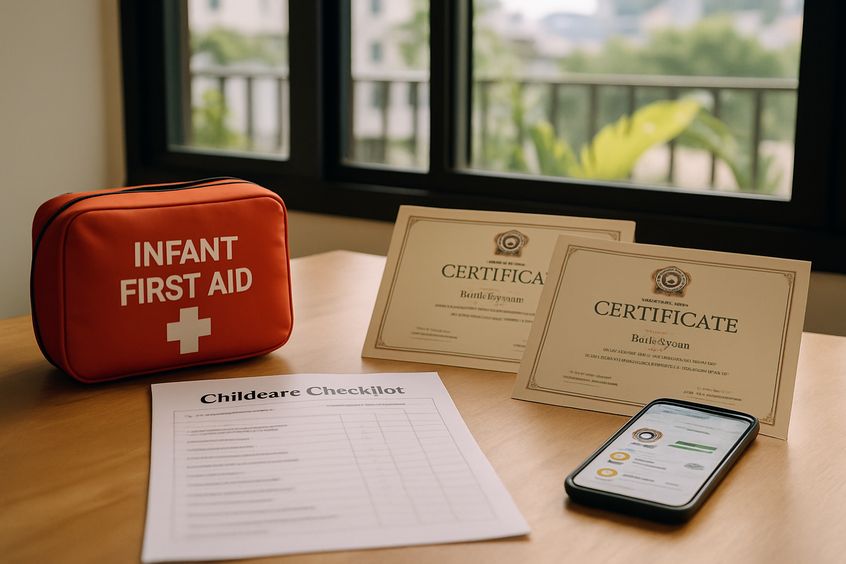
Credentials in childcare are useful when they map to everyday family risk. Parents are not paying extra for framed certificates. They are paying extra for confidence that real situations will be handled well.
In Bangkok, three skill clusters tend to raise earning power fastest:
- Safety and emergency readiness - especially choking response, fever escalation judgment, and age-appropriate first aid.
- Development-focused care - age-appropriate play, language-rich interaction, sleep and routine consistency, and healthy boundaries.
- Communication discipline - clean daily updates, clear notes on behavior or health changes, and respectful boundary setting with parents.
For salary context, families and agency benchmarks often place entry and early-career nanny work around 15,000-22,000 THB per month, while more advanced, highly trusted roles often move toward 25,000-40,000 THB in premium cases. If you are researching lead nanny salary Bangkok expectations, this range is a practical starting point before adjusting for hours and role complexity. Using the exchange rate of 1 USD = 32.63 THB (as of April 2026), that is roughly $460-$670 for earlier stages and about $770-$1,230 for senior ranges. Exact numbers vary by hours, district, language requirements, and whether live-in support is part of the package.
The key pattern: compensation grows with verified outcomes. Families pay more when a caregiver repeatedly proves reliability during messy, unpredictable days.

Caregivers building a nanny career path Thailand strategy should think in 6-12 month skill cycles. For people asking how to become a professional nanny in Bangkok, this step-by-step skill cycle is usually the most reliable path. Pick one practical certification, improve one measurable routine skill, and collect references tied to specific outcomes. This is usually more effective than taking many short courses without visible behavior change.
How families evaluate senior caregivers (and how to prepare)
Families hiring for lead nanny potential usually run a silent checklist, even when they do not call it one. They are observing whether the caregiver helps a child feel secure, whether the home routine becomes smoother, and whether communication improves under stress.
A common hiring mistake is over-weighting interview polish. Some candidates interview beautifully but struggle in real routines. Others are less polished but deeply consistent with children. That is why paid trial shifts and scenario-based questions matter so much.
Useful scenario prompts include:
- "What do you do if a child refuses dinner for three days in a row?"
- "How would you handle a sudden change in pickup schedule with both parents traveling?"
- "What details do you include in an end-of-day update for a toddler?"
Strong senior candidates answer with clear steps, not vague reassurance. They can explain how they prioritize child safety, emotional stability, and communication flow with parents.
This is also where platform quality matters. Instead of starting from guesswork, families can compare service scope across and practical guidance on . The goal is not to make hiring complicated - it is to reduce mismatch, turnover, and stress.

For caregivers, preparation is straightforward but not easy. Keep a concise portfolio of responsibilities you have owned, references that describe specific outcomes, and examples of how you handled hard days. That evidence travels further than generic claims.
How FamBear helps caregivers and families match better
Childcare career growth Thailand becomes more realistic when expectations are explicit on both sides. Families need confidence. Caregivers need fair positioning. FamBear helps by turning matching into a structured process with clearer role signals, not just a generic listing page.
For families, that means easier comparison of role fit before the first interview. For caregivers, that means stronger visibility for practical strengths, including nanny training Thailand progress and real progression readiness.
Over time, this produces better outcomes for everyone: better placements, fewer restarts, and a healthier pipeline from first babysitting jobs to lead nanny responsibility.
If you are hiring now, start with the role you actually need today. If you are a caregiver planning your next move, build proof one stage at a time. The Bangkok market rewards consistency.
Frequently Asked Questions
A babysitter is usually hired for occasional coverage, while a nanny is hired for consistent daily childcare routines. In practice, nannies handle more planning, communication, and long-term continuity for the family.
How can a babysitter become a professional nanny in Thailand?The usual path is consistent part-time work, strong references, then full routine ownership for one or more families. Caregivers who document outcomes and improve communication quality tend to move up faster.
Do I need certifications to become a lead nanny in Bangkok?Certifications are helpful, especially for first aid and child development basics, but families still evaluate real-world reliability. The best combination is practical experience plus skills that can be demonstrated during trials.
How much can a lead nanny earn in Bangkok?Senior nanny roles are commonly discussed in higher salary bands than entry babysitting, especially in expat-heavy areas and complex schedules. Actual pay depends on role scope, hours, language needs, and verified performance.
What skills help caregivers get better jobs faster?Three skills are consistently valued: emergency readiness, strong day-to-day communication with parents, and the ability to run child routines independently. These reduce stress for families and make role progression much easier.