For many families in Bangkok, "child falls from windows" sounds like a problem from older buildings only. That assumption is understandable - and partly true.
In many modern condos, windows are fixed panels or open only in limited ventilation mode. This design can reduce one major type of accident.
But safety risk has not disappeared. It has shifted.
Today, for many urban families, the highest risk is often not a classic wide-open casement window. It is a combination of balcony access, sliding doors, climbable furniture, and short attention gaps during normal daily routines.
This guide is built for real Bangkok family life: condo living, caregivers, school rush hours, and visits to other homes.
Good news first: modern condo design often lowers basic window risk
Many new residential towers in Bangkok use one or more of these features:
- fixed glass sections that do not open,
- narrow ventilation openings,
- built-in opening limiters,
- high sill heights in some layouts.
These features matter. They can significantly reduce direct access to large open window gaps for young children.
But they are not a full safety system by themselves.
A home remains safe only when the design features are combined with behavior rules and environment setup.
Where risk usually remains in modern Bangkok homes
1) Balconies and sliding doors
Even in units with safer windows, balcony access can still create a serious risk. Children can move quickly, especially when a door is left open for airflow, laundry, plants, or pet access.
2) Climbable furniture near openings
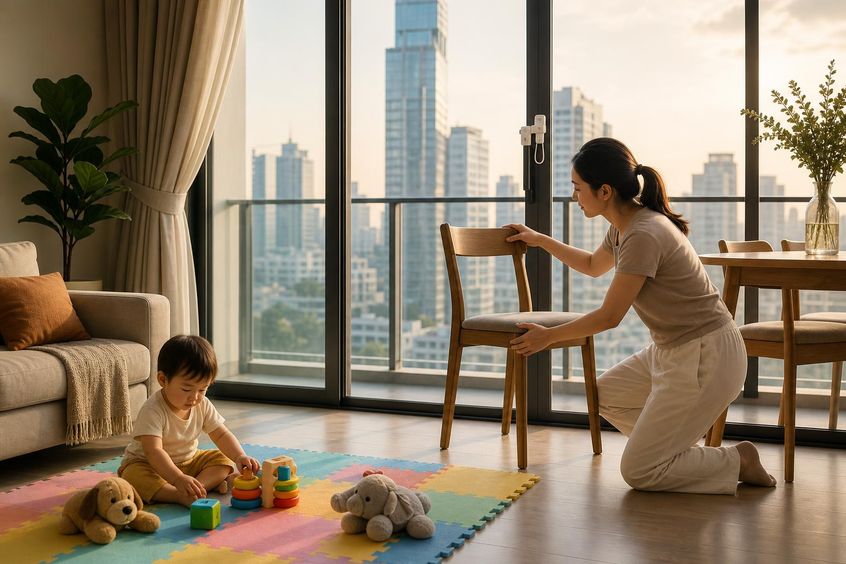
A stable chair, toy storage box, low shelf, or bed placed near a door or window can function like a step ladder for a toddler.
3) Older condos, townhomes, and temporary stays
Bangkok has a mixed housing stock. Families may live in modern buildings but frequently visit places with very different safety conditions: grandparents’ apartments, short-term rentals, holiday units, or friends’ homes.
4) Supervision gaps during normal tasks
Most incidents do not come from "careless parents." They happen during real-life moments: preparing meals, helping another child, answering a delivery call, or switching responsibilities between adults.
A practical condo safety setup that works
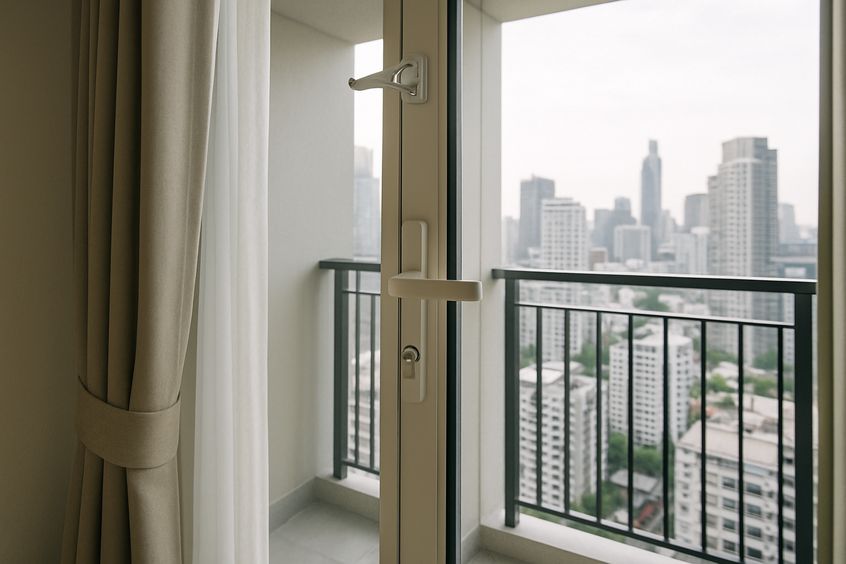
Step 1: Keep existing safety hardware intact
If your windows have factory limiters or fixed sections, do not remove or loosen them for convenience.
If airflow is a concern, choose safer alternatives:
- timed ventilation when children are sleeping,
- fan-assisted airflow,
- air purifier support during PM 2.5 periods,
- opening only inaccessible panels where possible.
Step 2: Treat the balcony as a priority safety zone
Use clear, simple rules:
- balcony door locked when not actively used,
- no unsupervised child access,
- no climbable objects near railings,
- "one adult actively watching" when children are on the balcony.
If your building allows it, install child-safety latches at upper reach height on sliding doors.
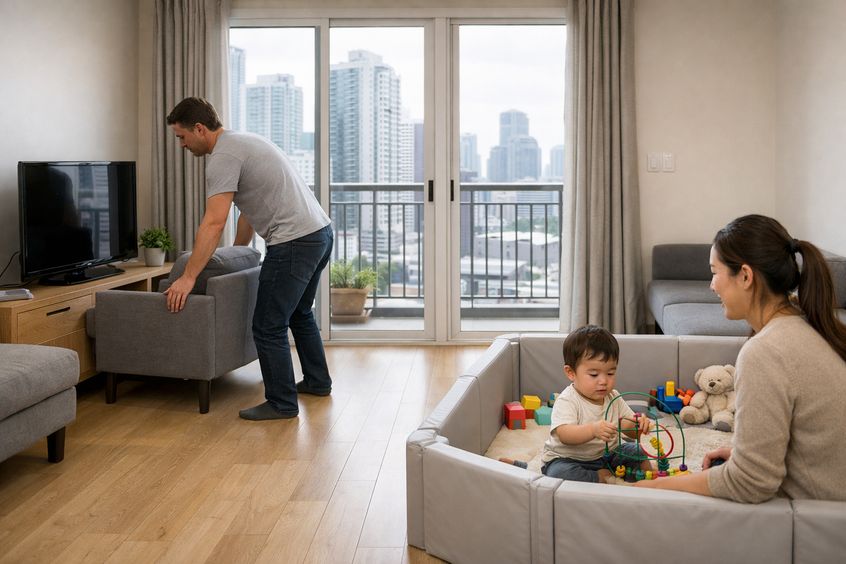
Step 3: Create a clear no-climb zone around openings
Check one meter around windows and balcony doors. Remove or reposition:
- stools,
- toy baskets,
- light chairs,
- low side tables,
- foldable furniture.
Children do not need a tall ladder. They need one small boost.
Step 4: Use active-watch handoff language
When multiple adults are present (parents, nanny, grandparent), avoid vague assumptions like "someone is watching."
Use explicit handoff phrases:
- "I am on watch for the next 15 minutes."
- "Can you take watch now while I shower?"
- "Door is open, I am watching both kids."
This sounds simple, but it removes one of the most common safety failures: unclear responsibility.
If you have a nanny or caregiver: set one shared protocol
A strong household routine should be documented and discussed, not assumed.
Your childcare protocol can include:
- which doors/windows must stay locked,
- what is never allowed (child alone on balcony),
- where furniture must not be placed,
- who to call first in an incident,
- what to do before nap time and before evening routine.
Treat this as a short operating checklist, not a long policy document.
The overlooked risk: visits, playdates, and travel stays
Many families make their own home safer, then lose control in other locations.
Use a 60-second arrival check every time you enter a new place with children:
- Are any doors/windows child-reachable and currently unlocked?
- Is there climbable furniture near balcony rails or window openings?
- Can we lock or block access now?
- Who is active watcher while we settle in?
This single routine can prevent incidents in otherwise "normal" visits.
Quick 5-minute audit for this week
Do this once now, then repeat monthly.
- Walk through every room and balcony with child-eye perspective (knee height).
- Test locks and latches with one hand occupied (for example, while carrying a small bag).
- Remove one unnecessary climbable object near openings.
- Confirm caregiver/parent watch handoff phrases.
- Save emergency contacts on every adult’s phone.
What to do if a fall happens
If severe symptoms appear - loss of consciousness, repeated vomiting, seizure, breathing difficulty, unusual drowsiness, unequal pupils, or major bleeding - call emergency services immediately (in Thailand, EMS is 1669).
Even if a child looks "mostly okay" after a significant fall, seek medical assessment promptly. Internal injuries are not always obvious in the first minutes.
*This article is for practical family safety education and does not replace medical advice.*
Final takeaway for Bangkok families
Modern condo design is a meaningful advantage. Fixed panes and limited-opening windows can reduce risk.
But "reduced risk" is not "no risk."
The strongest prevention model in Bangkok is layered:
- safe building features,
- controlled balcony access,
- furniture placement discipline,
- explicit adult handoff,
- and safety checks in temporary environments.
You do not need a perfect home. You need a repeatable system that still works on busy days.
Frequently Asked Questions
You are safer on that specific window risk, but not automatically safe overall. In many modern units, balcony access and climbable furniture become the dominant risk pathways, so your prevention plan still matters.
Is balcony safety really more important than window safety in new condos?In many newer Bangkok properties, yes. Where windows are fixed or strongly limited, balconies and sliding doors are often the practical exposure point for toddlers and preschoolers.
Are mosquito screens enough to prevent falls?No. Insect screens are not fall-protection systems. They are designed for pests, not body weight or impact.
What is the most common process mistake at home?Unclear supervision ownership during busy moments. Families often assume someone else is watching. A clear verbal handoff for active watch is one of the highest-impact fixes.
Should we run the same checks when visiting friends or staying in Airbnb units?Absolutely. Unfamiliar homes are a known blind spot. A 60-second arrival safety check should be routine before children start exploring.