

If you are raising a child in Bangkok, choosing between a nanny, daycare, and preschool is rarely a simple yes-or-no decision. Most parents are balancing three pressures at once: development needs at a specific age, work schedules that can change weekly, and a budget that must include more than tuition alone.
This guide gives you a practical framework you can use in one sitting, then test in real life before you commit long-term.
Start with the 3 option reality
In Bangkok, families usually compare these paths:
- Nanny: home-based one-on-one care, either full-time, part-time, live-in, or live-out.
- Daycare: group care with longer operating windows and flexible attendance formats in some centers.
- Preschool: structured early-learning environment, usually with fixed school-like schedules and term-based fees.
The mistake is trying to pick a universal winner. There is no universal winner. There is only what fits your child and your week.
The framework: 3 decision maker
Use these three step decision in order:
- Child stage (age 1-4): what your child needs most right now.
- Schedule reliability: how predictable your family calendar is.
- True monthly cost: full cost including hidden and irregular items.
If two options score similarly, use a hybrid model instead of forcing an all-or-nothing choice.
Step 1: Child stage first, not parent preference
Ages 1-2 (early toddler)
Most children in this stage do best with consistency, short transitions, and predictable routines. A strong nanny setup often works well here because care happens in one environment with fewer handoffs.
A daycare can still work if:
- caregiver-child ratio is low,
- transition support is clear,
- nap and feeding routines are aligned with home.
Ages 2-3 (social expansion stage)
Many children begin benefiting from regular peer interaction and structured play schedule. This is where daycare or preschool-lite schedules can become attractive, especially if your child is comfortable with separation.
At this stage, parents often move to mixed models:
- part-time group setting for socialization,
- nanny or family support for the rest of the day.
Ages 3-4 (school-readiness stage)
For many families, this is where preschool becomes a stronger fit because routine, group behavior, communication, and pre-academic foundations matter more.

That does not automatically remove the need for nanny help. A preschool schedule can still leave large gaps around commute, sick days, and holiday periods.
Step 2: Schedule reliability decides operational stress
A good childcare plan is not only about child development. It is also about whether your family can execute the plan every week.
If your schedule is stable
Examples:
- fixed office hours,
- predictable pickup windows,
- limited evening work spillover.
You can usually run daycare or preschool smoothly, especially if commute routes are short and backup adults are available.
If your schedule is unstable
Examples:
- shift work,
- unpredictable meetings,
- frequent travel,
- irregular late finishes.
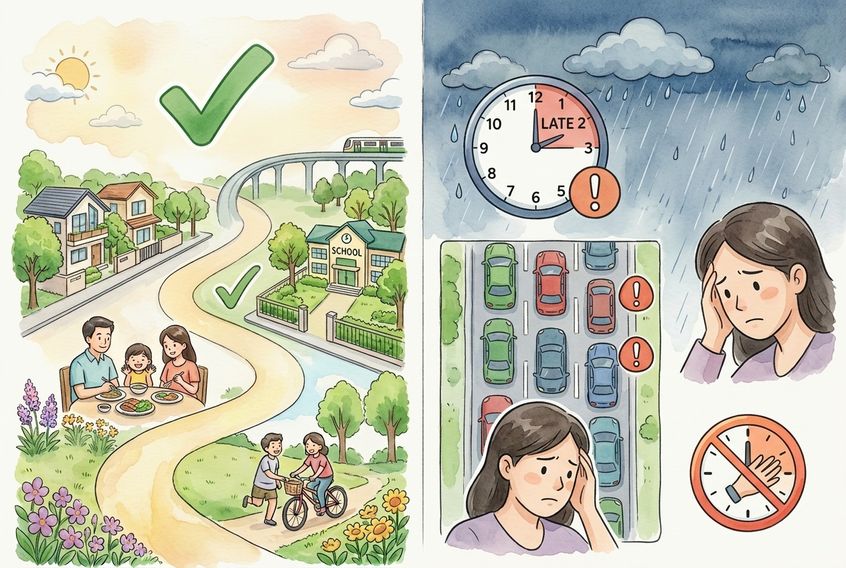
A nanny or hybrid setup is often safer because fixed school pickup deadlines can become a daily stress source. Families underestimate this until the first month.
The backup test (mandatory)
Before you choose any option, answer this:
Who covers care when your primary arrangement fails on short notice?
If your answer is unclear, do not commit yet. Build backup first through:
- one secondary caregiver,
- one emergency transport plan,
- one pre-agreed trigger for activating backup.
If you need emergency or short-notice support, pre-check babysitter services in Bangkok before enrollment deadlines lock you in.
Step 3: True monthly cost, not brochure cost
Parents often compare headline prices and miss the real number. Use a full-cost view.
Typical cost structure by option
| Option | Core cost type | Common additional costs |
|---|---|---|
| Nanny | Monthly salary or hourly rate | social security, food/transport support, overtime, agency fee, annual bonus |
| Daycare | Monthly or package blocks | registration, meals, extended hours, late pickup fees, transport |
| Preschool | Term fees + registration | uniforms, materials, activities, transport, after-class care |
Current market signals to include in your budget sheet
Recent public pages in Bangkok show why cost comparison is tricky:
- Nanny guidance pages frequently cite broad salary ranges depending on experience and schedule type.
- Preschool pages can include substantial registration fees and term structures.
- Daycare programs may offer flexible block models, but late pickup or extensions can add up.
Practical examples from currently accessible pages:
- Noddy by Elizabeth's lists registration and term-based fee structure on its tuition page.
- Storytime highlights rolling enrollment and temporary registration promotions.
- OISCA lists drop-in blocks and extended-hour pricing.
- KidsClie lists short-format care packages and validity windows.
This is why families should calculate the 12-month total before choosing, not only one monthly line.
A simple decision matrix for parents
Score each option from 1 (weak fit) to 5 (strong fit).
| Criteria | Nanny | Daycare | Preschool |
|---|---|---|---|
| Fit for your child’s current stage | |||
| Fit for your weekly schedule | |||
| Predictability of monthly spending | |||
| Commute and transfer burden | |||
| Backup resilience | |||
| Transition risk for your child |
Then apply one rule:
- If one option leads by 4+ points, choose it.
- If two options are within 3 points, run a hybrid pilot for 4 weeks.
The hybrid model that often works in Bangkok
Many families do better with combination plans than with pure single-mode care.
Hybrid A: Preschool/daycare core + nanny bridge
Best for:
- ages 3-4,
- parents with moderate schedule variability,
- families needing school-readiness plus flexible afternoon coverage.
Hybrid B: Nanny core + 2-3 social sessions weekly
Best for:
- ages 1-3,
- children who need gradual social exposure,
- parents prioritizing home routine stability.
Hybrid C: Daycare core + babysitter contingency
Best for:
- cost-conscious planning,
- families with occasional late meetings,
- households with limited extended family backup.
If you want to compare in-home options first, review nanny services and then layer group care where needed.
Red flags that should pause your decision
No matter which option you prefer, pause and re-check when you see these signs:

- You have not validated backup care for sick days and closures.
- You are choosing based only on social media opinions.
- You do not have a written monthly cost sheet.
- Commute time exceeds your child’s tolerance window.
- Trial period is skipped because of urgency pressure.
Urgency is real, but rushed commitment is expensive.
14-day validation sprint before long-term commitment
Use this short test instead of making a six- or twelve-month decision immediately.
Days 1-3: Baseline mapping
- Track your child’s sleep, meals, mood, and separation response.
- Track your actual work commitments and pickup constraints.
- Estimate worst-case commute times, not best-case.
Days 4-7: Option stress test
- Run one trial day with your leading option.
- Log transition friction points.
- Record total cost for that trial day including add-ons.
Days 8-11: Backup simulation
- Simulate one disruption: rain delay, late meeting, or caregiver cancellation.
- Test whether backup activates without chaos.
Days 12-14: Decide with evidence
- Fill the score matrix.
- Compare cost and stress notes.
- Choose primary + backup plan together.
The goal is not perfection. The goal is a setup your family can repeat calmly.
What to ask providers before paying
For nanny candidates or agencies
- What exact hours and overtime terms are included?
- How are sick days, holidays, and emergency absences handled?
- Is there a trial period with clear exit terms?
For daycare and preschool operators
- What are full annual costs beyond tuition?
- What is the late pickup policy in real practice?
- How many transition days are recommended for new children?
- How are closures and illness events communicated?
For yourself as a parent
- Can we sustain this plan for 90 days without burnout?
- Do we have a realistic backup, not a hopeful backup?
- Does this choice fit our child now, not six months ago?
Final takeaway
For Bangkok families with children aged 1-4, the best childcare choice is usually the one that balances development fit, schedule reality, and full-year cost with the least operational stress.
Use the 3 decision maker, score your options, run a short validation sprint, and commit only after backup is defined. If you want to keep multiple paths open while deciding, start with Bangkok childcare options and build a practical plan around your real week, not an ideal one.
Frequently Asked Questions
Not always, but many children in that stage do better with predictable one-to-one care and fewer transitions. A small, well-run daycare can also work if routines and caregiver continuity are strong.
How should we compare nanny and daycare costs fairly?Use a 12-month total, not headline price only. Include registration fees, transport, overtime, meals, late pickup fees, bonuses, and emergency backup costs.
At what age does preschool usually become the stronger option?For many families, ages 3-4 is the turning point because group routine, communication, and school-readiness start to matter more. But schedule flexibility and backup coverage still affect the final choice.
What if both parents have unpredictable work hours?A fully fixed childcare setup can create daily stress. In that case, a nanny-led or hybrid plan is often safer because it handles delays, sick days, and short-notice changes better.
Can we combine options instead of choosing only one?Yes. Many Bangkok families use hybrid models, such as part-time preschool with nanny bridge coverage, or daycare core with babysitter contingency for late days.
What is the most important step before committing?Run a short trial period and test one real disruption scenario. If your backup plan fails during a trial week, fix that first before signing long-term agreements.