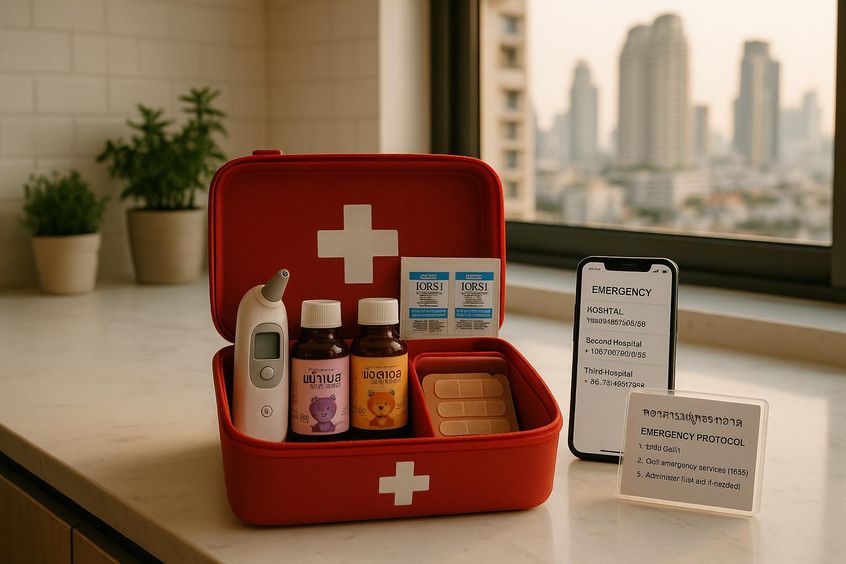
Your phone buzzes during a meeting. It's your nanny: "Baby hot. Very hot." Two words in English, a photo of a flushed toddler, and suddenly you're trying to triage your child's health from across the city. If you've lived in Bangkok with young children long enough, this moment isn't hypothetical. It's Tuesday.
The difference between panic and a calm, handled situation almost always comes down to what you prepared before the phone rang. I've talked to dozens of expat families here, and they all say the same thing: that emergency plan you scribble out on a lazy Sunday afternoon is what saves you on a chaotic Wednesday.
Why Every Bangkok Family Needs a Nanny Sick-Child Protocol
Bangkok presents a particular mix of childhood health risks that families in, say, London or San Francisco simply don't face. Dengue fever affects children aged five to fourteen most aggressively, and Thailand recorded a 65.7 percent increase in hand-foot-mouth disease cases in 2025 alone, with Bangkok reporting the highest numbers.
Then there's the stuff that sneaks up on you. Year-round influenza (no tidy seasonal pattern like back home), gastroenteritis from food and water, and respiratory flare-ups during the city's awful PM2.5 pollution season from November through March. Pediatricians at Samitivej Children's Hospital see over 50,000 young patients every year, which tells you something about how often kids get sick here.
For expat families, everything gets harder. The language barrier is real. The healthcare system works differently than what you're used to. And there's a cultural gap in how illness gets communicated that catches a lot of parents off guard. A German journalist and mother of two who's been in Thailand since 2019 wrote on her blog NomadMum: "Thais are so polite that they often don't tell you when they disagree. They just say yes and then do it differently." In a medical context, that tendency - known in Thai as kreng jai, the reluctance to impose or deliver unwelcome news - can mean your nanny notices symptoms but hesitates to alarm you. A clear, written protocol eliminates the guesswork for everyone. For a broader look at keeping children safe with caregivers, see our guide on child safety with a caregiver in Bangkok.
What Your Nanny Should Do When Your Child Gets Sick
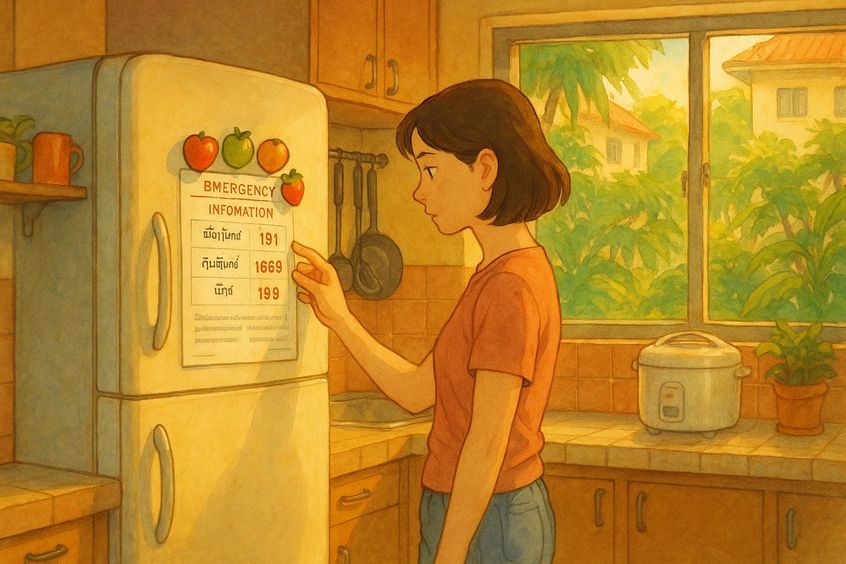
The most effective sick-child plans work like a simple decision tree, and your nanny needs it printed, laminated, and stuck to the fridge - in both Thai and English.
Step 1: Symptom assessment. A fever under 38.5 degrees Celsius usually calls for monitoring, children's paracetamol (Sara is the common Thai brand), and a body sponge - wiping the child's skin with a damp cloth from the hands and feet toward the torso. This is standard practice across Thai hospitals. Your nanny should call you, but there's no rush to the emergency room.
Step 2: Contact parents. Between 38.5 and 39.5 degrees, things move faster. Your nanny should call you right away and start getting ready to leave for the hospital. Have a bag packed with the child's insurance card, passport copy, and a list of allergies and current medications. Families on the FamBear platform can store emergency documents directly in caregiver profiles, so your nanny has everything on her phone without rifling through drawers.
Step 3: Emergency action. Above 39.5, or if your child has a seizure, difficulty breathing, persistent vomiting, or signs of an allergic reaction, the instruction is simple: call 1669 for an ambulance and head to the hospital. Call the parents on the way. Every minute spent trying to reach mom or dad first is a minute lost.
Step 4: Suspected dengue. This deserves its own line in the protocol. If your child spikes a high fever with a rash, body pain, or pain behind the eyes, that's a hospital trip regardless of the temperature reading. Dengue can go downhill fast in children, and the "wait and see" approach that some expat forums casually recommend is genuinely dangerous for young kids. One parent on Reddit described contracting dengue in Bangkok as "every bit of horrible as it is described in medical journals" - and that was an adult. Children are more vulnerable to the hemorrhagic form.
Best Pediatric Hospitals in Bangkok for Emergencies
When you write your nanny's emergency plan, pick one hospital and make it the default. Decision fatigue in a crisis helps nobody.
Samitivej Children's Hospital on Sukhumvit 49 is the most popular choice among expat families, treating over 50,000 pediatric patients a year including 3,700 international admissions. They run a 24-hour pediatric emergency room with excellent English-speaking staff, plus Japanese, Chinese, and Arabic interpreters. A typical ER visit with consultation and basic medication runs around 3,000 to 8,000 baht.
Bumrungrad International on Sukhumvit Soi 3 is another solid option with a full pediatric center and staff who speak over 20 languages. Bangkok Hospital on Soi Soonvijai and the newer MedPark Hospital on Rama 4 both have strong 24-hour emergency departments too.
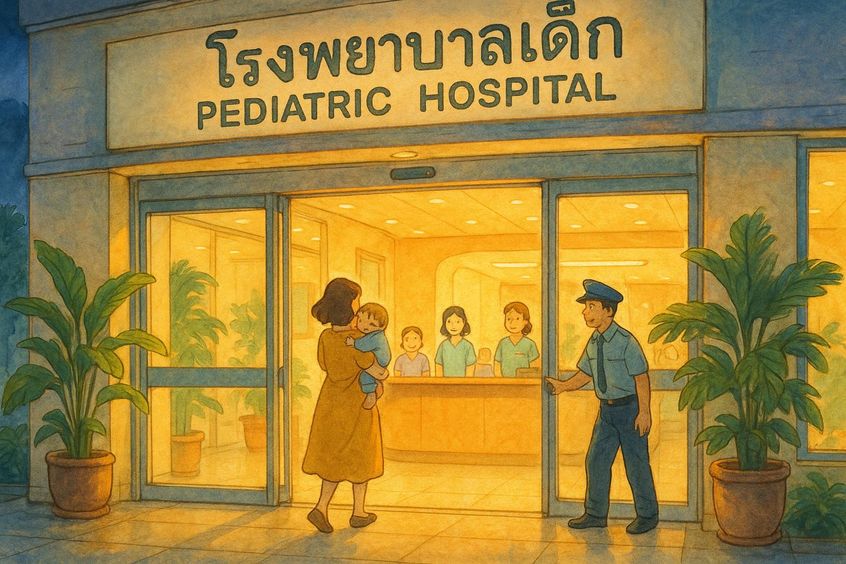
If cost matters - and for most families it does - a GP consultation with basic medication at a private hospital typically runs 1,500 to 3,000 baht, roughly $40 to $90 as of March 2026. Emergency room visits are usually two to three times that. Public hospitals are much cheaper but come with longer waits and limited English, which makes them tough when your nanny is the one navigating the visit alone. To get a better sense of overall childcare expenses, check out our breakdown of how much a nanny costs in Bangkok.
One thing worth knowing: Phyathai Hospital runs a 24-hour Child Ambulance service built for situations where a caregiver can't transport a sick child. Put that number on your nanny's emergency sheet.
Emergency Numbers Every Nanny Must Know
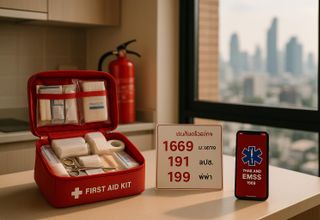
Thailand doesn't have a single universal emergency number the way many Western countries do. Different emergencies route to different lines, and not all operators speak English. Your nanny needs these numbers saved in her phone and written on the fridge.
Medical emergencies: 1669 connects to ambulance dispatch. Police: 191, and since 2015 you can also dial 911. The Tourist Police at 1155 have English, Chinese, and Japanese speakers available. For suspected poisoning, the Ramathibodi Hospital Poison Centre answers at 1367. And save your chosen hospital's direct line - Samitivej at 02-022-2222, Bumrungrad at 02-066-8888, or Bangkok Hospital at 02-310-3000. Calling the hospital directly often gets faster results than the national ambulance line.
Creating a Nanny Emergency Plan That Actually Works
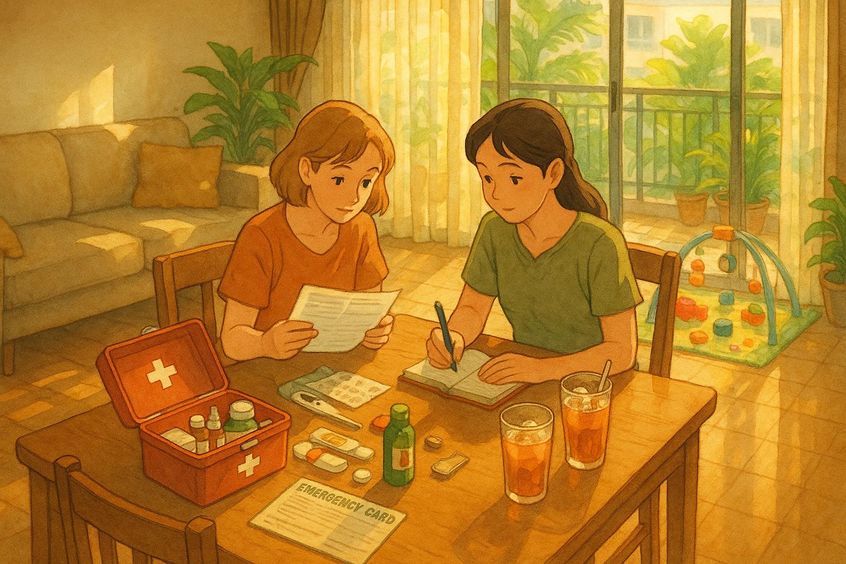
The parents who handle childhood illness most smoothly aren't the ones with medical degrees. They're the ones who wrote things down ahead of time. One parent on Reddit's r/NannyEmployers shared their approach: a single sheet per child with date of birth, blood type, known allergies, current medications, pediatrician's name and number, preferred hospital with address, insurance policy number, and an authorization statement: "[Nanny name] is authorized to seek emergency medical care for [child name] and make treatment decisions if parents cannot be reached."
That last line matters more than you'd expect. Thai hospitals can be hesitant to treat a child brought in by someone who isn't a parent, especially a non-Thai caregiver. Having written authorization, ideally with a photocopy of the parent's passport and the child's birth certificate, smooths the process a lot.
On the practical side: keep 5,000 baht in emergency cash somewhere your nanny can access it - around $140 as of March 2026. Make sure Grab or Bolt is installed and logged in on her phone. If your child takes any regular medication, make sure the nanny knows the dosage and schedule, and write it down even if she says she remembers. "Yes, I understand" doesn't always mean what it means in English. I've heard that from enough families to know it's not a stereotype - it's a communication pattern you need to plan around.
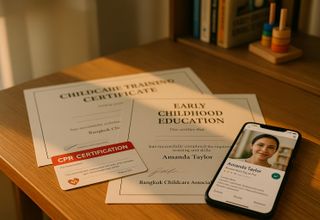
When families work with FamBear's nanny service, caregivers go through verification that includes practical childcare skills assessment before they ever show up in search results. That covers exactly these scenarios - how a caregiver responds to a feverish child, whether she knows when to call for help, whether she can stay calm under pressure. There's a real difference between hoping your nanny will handle an emergency and knowing she's been tested on it.
Communication Tips for Thai Nannies and Expat Families
The cultural dimension of nanny communication in Bangkok is something most advice articles ignore entirely, but it's often where things break down. A nanny who grew up in Thai culture may genuinely believe that bothering you at work with "just a small fever" is rude.
She may try home remedies first - Ya Mong herbal balm on the temples, a Ya Dom inhaler for congestion - before saying anything. These remedies aren't harmful (menthol-based balms do have documented efficacy for headaches and congestion), but you need to know they're happening.
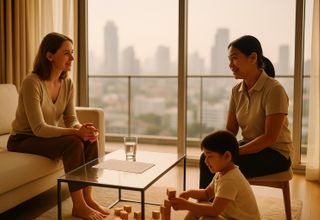
The fix takes effort upfront but pays off fast. Write your expectations clearly, in Thai if possible. Be specific: "Call me immediately for any fever, vomiting, rash, or if the child seems unusually tired or won't eat. I will never be angry at you for calling. I will be upset if you don't call." Have a Thai-speaking friend or translator check the document so the nuance lands right.
The NomadMum blogger learned this the hard way: "We've had nannies who thought Coke was great for toddlers and Netflix was the hit for babies. But that was our mistake. We didn't communicate clearly how we envisioned parenting and feeding." She solved it by creating written instructions in Thai. Simple, but it worked.
For families looking to find a trusted babysitter in Bangkok, FamBear's caregiver profiles include verified skill assessments and communication capability ratings. That helps match families with caregivers who can navigate these conversations more naturally from day one.
Insurance and Healthcare Costs to Plan For
Health insurance isn't optional when you have children in Bangkok. As one insurance specialist put it: "Kids get sick. A lot. Outpatient coverage becomes essential with children."
A family plan for a parent in their mid-thirties with two young children runs about $280 per month as of March 2026, depending on the provider and coverage level. Pacific Cross, Cigna, and APRIL International are the names that come up most often for expat families in Thailand.
The thing to really think about, as one expat insurance guide noted: "When children are involved, stability and hospital access usually matter more than saving a few thousand baht per year." Make sure your policy covers the private hospitals you'd actually use in an emergency, and confirm your nanny can present the insurance information on your behalf.
Children in Bangkok get sick constantly. Thai parents on the Pantip forum describe kids under three falling ill nearly every month, bouncing between colds and throat infections. "We practically live at the hospital," one mother wrote. That's normal here, and it's manageable with the right preparation.
The families who handle it best are the ones who treated the planning like a project: picked a hospital, wrote the protocol, prepped the emergency kit, briefed the nanny in her own language, and then went back to living their lives knowing the system would work when they needed it. FamBear's blog has additional resources on child safety with caregivers worth bookmarking alongside your emergency plan.
Your nanny's job isn't to be a doctor. It's to stay calm, follow the plan, and get your child to someone who is.
Frequently Asked Questions
What should I do if my child gets sick while with the nanny in Bangkok?
Make sure your nanny has a written sick-child protocol before anything happens. The plan should include symptom thresholds (when to monitor at home versus when to go to the hospital), your preferred pediatric hospital's name and address, emergency contact numbers, and a medical authorization letter. For fevers under 38.5 degrees Celsius, home monitoring with children's paracetamol and body sponging is usually appropriate. Above 39.5 degrees, or if the child has difficulty breathing, seizures, or persistent vomiting, your nanny should call 1669 for an ambulance and head to the hospital immediately.
Can a nanny take my child to a hospital in Bangkok without parental permission?
Thai hospitals may hesitate to treat a child brought in by a non-parent, especially a foreign caregiver. To avoid delays, prepare a signed authorization letter stating that your nanny is permitted to seek emergency medical care and make treatment decisions on your behalf. Include a photocopy of your passport and the child's birth certificate. Keep this document with your nanny at all times, along with the child's insurance information and allergy list.
What are the best pediatric hospitals in Bangkok for expat families?
Samitivej Children's Hospital on Sukhumvit 49 is the most popular choice, treating over 50,000 pediatric patients annually with 24-hour emergency care and multilingual staff. Bumrungrad International on Sukhumvit Soi 3 offers a full pediatric center with staff speaking over 20 languages. Bangkok Hospital on Soi Soonvijai and MedPark Hospital on Rama 4 are also excellent options. All four have 24-hour pediatric emergency departments with English-speaking doctors.
What is the emergency number for an ambulance in Thailand?
The medical emergency and ambulance number in Thailand is 1669. Unlike many Western countries, Thailand does not have a single universal emergency number. Police emergencies use 191 (or 911, which also works since 2015), the Tourist Police with English speakers are at 1155, and the Ramathibodi Hospital Poison Centre is at 1367. Save your chosen hospital's direct emergency line as well, as calling the hospital directly often gets a faster response.
What emergency information should I leave for my nanny in Bangkok?
Prepare a printed sheet for each child containing their full name, date of birth, blood type, known allergies, current medications with dosages, pediatrician's contact details, preferred hospital name and address, insurance policy number and provider phone, a signed medical authorization letter, and at least three emergency contact numbers besides your own. Keep 5,000 baht in accessible emergency cash and make sure your nanny has a ride-hailing app installed on her phone. Write everything in both Thai and English.
Should my nanny care for my child when they have dengue fever or hand-foot-mouth disease?
Neither dengue fever nor hand-foot-mouth disease should be managed at home without medical guidance, especially in young children. If your child has a high fever with a rash, body pain, or pain behind the eyes, your nanny should take them to the hospital immediately regardless of the temperature reading. Dengue can deteriorate rapidly in children. Hand-foot-mouth disease, which saw a 65.7 percent increase in Thailand in 2025, is highly contagious and may require medical assessment. In both cases, the nanny's role is to recognize the warning signs and get professional help, not to treat the illness herself.