A 21-year-old woman posted on Pantip last year asking how to become a professional nanny. The responses surprised her. Some commenters warned that formal training courses carry a social stigma - that enrolling in a "nanny school" signals you couldn't find better work. Others pointed out that certified nannies command nearly double the salary of their untrained peers. That's the weird contradiction at the heart of nanny certification in Thailand: credentials are both looked down on and increasingly necessary. For anyone exploring caregiver training in Bangkok or elsewhere in the country, it doesn't quite make sense, but there it is.
Does Thailand Require Nanny Certification?
The short answer is no. Thailand has no mandatory licensing or certification requirement for nannies, babysitters, or in-home caregivers. Anyone can take the job. No government registry. No required exam. No minimum training hours before you start caring for someone else's child. This puts Thailand in line with most countries worldwide, where domestic childcare remains largely unregulated.
And honestly, that lack of regulation shows. Consider PeePee, a 21-year-old live-in nanny earning 15,000 THB per month. She works around the clock with no days off, and by her own account, she cries every night. Nobody asked for credentials before she started. Nobody taught her how to handle the emotional weight of full-time caregiving either. Her story is common - across Bangkok, thousands of young women enter domestic childcare with little preparation, often recruited through word of mouth or informal networks.

But the absence of legal requirements doesn't mean certifications are meaningless. If anything, it's the opposite. As one expat on Reddit put it, "Many expats find it hard to secure a good nanny," and the difficulty often comes down to having no reliable way to assess a candidate's skills. Certifications have become a voluntary trust signal - a way for caregivers to stand out and for families to filter candidates when there are no official standards to fall back on.
Top Caregiver Training Programs in Bangkok
Several organizations now offer structured training that has become the de facto standard for professional nannies in Thailand.
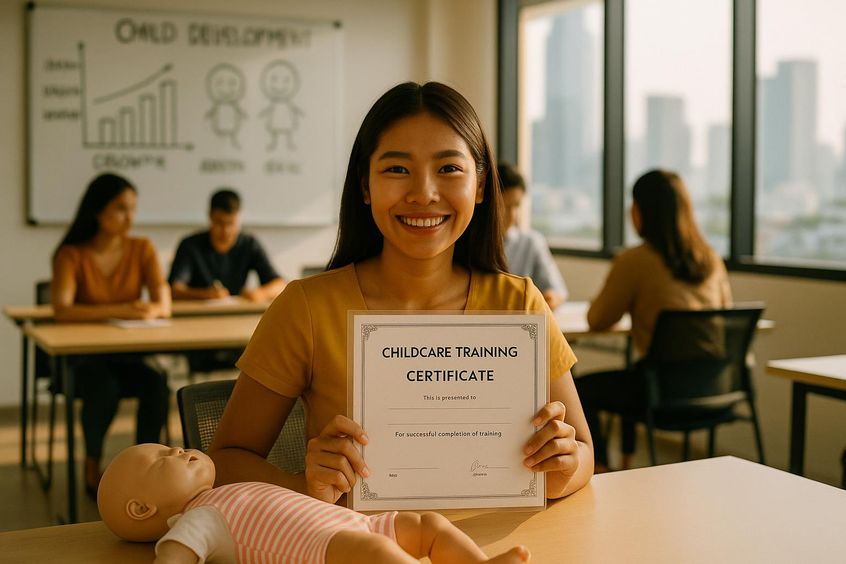
The most established is Thai Nanny School, which runs a 420-hour program certified by Thailand's Ministry of Education. It covers child development, nutrition, first aid, early childhood education techniques, and practical caregiving skills across roughly three months of full-time study. Graduates have gone on to work at luxury hotels like Lebua, SO Sofitel, and Trisara - places where children's club staff need real professional training, same as any other department. The program costs approximately 10,000 THB (around $285 USD as of April 2026). That's a lot for someone earning entry-level wages, no question about it. But it pays for itself fast through higher earning potential.
For caregivers who can't commit to three months of full-time study, the Thailand Professional Qualification Institute (TPQI) offers a free three-hour online childcare course that comes with a certificate upon completion. The course covers basics - safety awareness, age-appropriate interaction, hygiene protocols - and it won't carry the same weight as the 420-hour program, but it's a solid starting point. The Thai Red Cross also runs nanny training courses that combine childcare fundamentals with medical emergency response, and the Red Cross name gives those certificates instant credibility.
On the private side, ABRACADABRA operates a four-week Montessori nanny training program that focuses on creative development and child-led learning. One participant said, "The art work activities were so interesting and helpful," which gives you a sense of what the program prioritizes - hands-on methods over textbook theory. Several caregiver agencies also provide in-house training for their registered nannies, often partnering with Bangkok First Aid to deliver CPR certification as part of onboarding.
Each program fills a different gap. The 420-hour MoE-certified course is the gold standard for career nannies. The TPQI free course works for babysitters testing the waters. Montessori training appeals to families with specific educational preferences. CPR certification addresses the universal concern of child safety. None of this is required by law, but taken together, these programs increasingly shape who gets hired in Bangkok and at what rate.
Essential Certifications for Nanny and Babysitter Careers
Not all certifications carry equal weight, and understanding the hierarchy helps both caregivers and families make better decisions.
CPR and pediatric first aid certification sits at the top for a simple reason: it can save a child's life. A nanny who knows how to clear an obstructed airway or respond to an allergic reaction provides a safety level that experience alone can't match. Bangkok First Aid offers courses specifically tailored to infant and child emergencies. I'd go so far as to say this single certification often matters more than everything else on a resume combined, especially for families with young children.
The 420-hour MoE-certified program from Thai Nanny School functions as the closest thing Thailand has to a professional nanny qualification. It shows that a caregiver has put serious time into learning child development theory and practical skills. Hotels and high-net-worth families treat this certification as a baseline requirement, and agencies increasingly use it to justify premium placement fees.

Language certifications - particularly English proficiency - act as a powerful salary multiplier. Expat families in Bangkok, who make up a big chunk of the premium nanny market, need caregivers who can communicate clearly about their child's day, relay concerns, and follow detailed instructions. When families find a trusted nanny through platforms like FamBear, English ability combined with formal training consistently commands the highest rates.
Montessori or early childhood education certificates from programs like ABRACADABRA's training signal specialized knowledge. These appeal to a narrower audience - families who specifically want a caregiver aligned with a particular educational philosophy - but within that niche, they carry real weight.
How Certifications Boost a Caregiver's Career in Thailand
The salary data tells a clear story. Untrained nannies in Bangkok typically earn between 13,000 and 15,000 THB per month. Trained nannies with English proficiency earn 25,000 to 30,000 THB - roughly double. That gap, approximately $430 to $570 USD as of April 2026, is what certification is worth in real money.
But it goes beyond monthly pay. A caregiver who reviewed the caregiver career guide on FamBear's blog would see that certifications open doors to entirely different career tiers. Thai Nanny School graduates working at luxury hotels have structured schedules, benefits, and professional development - nothing like PeePee's 24/7 live-in situation with no days off. Reddit discussions about nanny pay tiers consistently identify three factors that determine salary: experience, English ability, and working hours. Certifications boost the first two.
Visibility matters too. When families search for a nanny on platforms like FamBear, they often filter profiles by certifications before reading a single review. Platforms that display credentials prominently give certified nannies a real advantage in the hiring process. Your certification becomes a searchable, sortable data point that puts you in front of families willing to pay more.
I want to be fair here, though. Some experienced nannies with decades of hands-on work and strong references earn premium rates without any formal certification. Experience genuinely matters, and a certificate can't substitute for being naturally great with kids. But for caregivers entering the field - especially younger ones like that Pantip poster asking about becoming a nanny - certifications offer a faster, more reliable path to higher earnings than waiting years to build up references.
What Families Should Look For in Caregiver Qualifications
Finding the right caregiver involves more than checking a credentials list, but credentials give you a useful starting point. As one Reddit expat noted, "Best bet is to use a nanny company... Nobody is ever going to be perfect," and that practical advice applies to evaluating qualifications too. No single certification guarantees excellence. But certain combinations signal genuine professionalism.
Families hiring a full-time nanny should prioritize CPR and first aid certification above everything else. After that, the 420-hour MoE program or equivalent structured training shows a caregiver who has invested meaningfully in the profession. Language skills matter for communication, and any specialized training - Montessori, special needs, infant care - should match the family's actual situation.
When families book a babysitter for occasional evening care, the bar is naturally lower. Basic safety training and the free TPQI certificate show a baseline level of awareness and professionalism. For regular babysitting arrangements that grow into something more ongoing, families can look for caregivers who are actively working toward additional training.

The interview still matters, no matter what's on paper. FamBear recommends that families prepare thorough interview questions that test how a caregiver would handle specific scenarios - a child choking, a tantrum in public, a medical emergency. Certifications tell you what someone studied. Interviews show you how they think when things go wrong.
Verification is worth the effort. Ask to see actual certificates, check with the issuing institution when possible, and pay attention to the specificity of what someone knows. A caregiver who can describe exactly what she learned in her CPR course - compression depth for infants versus toddlers, the protocol for calling emergency services - that's real knowledge, not just a credential collected for show.
Understanding nanny costs in Bangkok helps families set expectations properly. If a caregiver with the 420-hour certification and strong English asks for 28,000 THB per month, that falls within the market range for her qualifications. Families who understand the training investment behind those credentials are better positioned to negotiate fairly and keep quality caregivers around long-term.
Training Costs and Time Investment
The financial and time commitments for caregiver training in Thailand vary a lot, and understanding the range helps both caregivers and families plan realistically.
At the zero-cost end, the TPQI's free online course takes just three hours. It gives you a certificate and covers basic concepts, making it a perfect starting point for anyone thinking about childcare as a career. Nothing to lose. The credential is basic, sure, but it shows initiative.
The Thai Red Cross nanny training falls in the mid-range, typically requiring several days of instruction at a modest cost. The Red Cross name carries weight on its own, and the medical component gives graduates practical skills that families genuinely value.
At the professional end, the 420-hour Thai Nanny School program is the biggest commitment: roughly three months of full-time study and approximately 10,000 THB in tuition. For a nanny currently earning 15,000 THB per month, that tuition equals two-thirds of a month's salary. Not cheap. But graduates consistently move into positions paying 25,000 to 30,000 THB, so the investment pays for itself within the first two months at the higher rate. The math works out clearly.
ABRACADABRA's four-week Montessori training fills a specialized role, offering focused instruction in a specific educational methodology. The concentrated format appeals to caregivers who already have general experience but want to add something extra to their profile.
For caregivers weighing these options, here's how I'd think about it. The free TPQI course has zero downside - just do it. CPR certification from Bangkok First Aid or similar providers typically costs a few thousand baht and takes a day or two. Every professional caregiver should have it, full stop. Beyond that, it depends on what you want. Planning to work with expat families or in luxury hospitality? Pursue the full 420-hour program. Looking for occasional babysitting work? TPQI plus CPR training might be enough.
Families can explore our services on FamBear to connect with caregivers across all certification levels. The platform lets families filter by qualifications, which makes it easier to find someone whose training matches their needs and budget. Whether you need a fully certified career nanny or a responsible babysitter with basic safety training, knowing what each credential actually means helps everyone - caregivers and families - make better choices in a market where formal requirements may not exist but professional standards keep rising.
Frequently Asked Questions
Does Thailand require nanny certification?
No. Thailand has no mandatory certification, licensing, or registration requirement for nannies or in-home caregivers. Anyone can work as a nanny without formal training. However, voluntary certifications are increasingly valued by families and can significantly boost a caregiver's earning potential.
What is the best nanny training program in Thailand?
The 420-hour program at Thai Nanny School is widely considered the gold standard. It is certified by Thailand's Ministry of Education and covers child development, nutrition, first aid, and practical caregiving skills. Graduates have gone on to work at luxury hotels and with high-net-worth families across Bangkok.
How much does nanny training cost in Thailand?
Costs range from free to around 10,000 THB. The TPQI offers a free three-hour online childcare course with a certificate. The Thai Red Cross runs mid-range courses over several days. The full 420-hour Thai Nanny School program costs approximately 10,000 THB and takes about three months to complete.
How much more do certified nannies earn in Bangkok?
Untrained nannies typically earn between 13,000 and 15,000 THB per month. Trained nannies with English proficiency earn 25,000 to 30,000 THB - roughly double. The salary gap means the cost of training pays for itself within one to two months of working at the higher rate.
What certifications should families look for when hiring a nanny?
CPR and pediatric first aid certification should be the top priority, as it directly relates to child safety. Beyond that, the 420-hour MoE-certified program signals serious professional commitment. English proficiency and any specialized training in Montessori or infant care are valuable additions depending on the family's needs.
Is there free nanny training available in Thailand?
Yes. The Thailand Professional Qualification Institute (TPQI) offers a free three-hour online childcare course that includes a certificate upon completion. It covers safety awareness, age-appropriate interaction, and hygiene protocols. While it does not replace more comprehensive programs, it is an accessible starting point for anyone entering the field.